


Low risk, attractive returns. Speculative Big Box development is mispriced, and we expect that anomaly to correct.

Following Jake Huntley's analysis in 'The Race for Space' and last week's 'Something Has to Budge', which set out why big box development economics are so stretched, we turn to the case for speculative Big Box development. Our central contention is straightforward: the returns available in this part of the market are not commensurate with the risk taken to secure them. For investors prepared to underwrite carefully, big box remains the most compelling opportunity we are currently tracking.
The Risks
Planning. Securing consent remains slow and resource-intensive, notwithstanding recent improvements to the regime. In addition, section 106 & 278 agreements are expensive and prohibitive for some developers. But for well-conceived schemes, however, the risk is overwhelmingly one of timing rather than outcome: the question is when, not if. In the year ending March 2026, 6,300 decisions were made on applications for commercial development, of which 5,700, or 90%, were granted.
Power. Grid capacity is increasingly difficult to secure within sensible timeframes, a constraint that is only intensifying as automation and electric vehicle infrastructure raise the power demands of modern logistics facilities.
Construction cost. Cost inflation continues to work through the supply chain, led by structural steel, where July's tariff changes have moved section prices from £700 to £950 per tonne this year, and many contractors remain unwilling to hold tender prices for more than a few weeks. DXTRE's build cost tracking shows rises of 7% to 9.5% in the second quarter of 2026 alone, with further increases expected before year end. Something Has to Budge sets out the mechanics in full.
Leasing. This is the principal risk in big box. An error in location or specification can prove costly, exposing an asset to prolonged void periods or to weaker terms on letting.
The Rewards
A strong occupational market. The race for space is firmly back on, and nowhere more so than in Big Box. Rental growth forecasts are robust, underpinned by shrinking supply and strengthening demand. DXTRE's National All-Industrial five-year forecast points to rental growth of 3.3% per annum, with prime further ahead of that.
Stronger covenants. Occupiers of larger-scale units tend, by definition, to carry stronger balance sheets. They are also more willing to commit to strategically located facilities, a commitment that justifies the substantial fit-out and automation investment these buildings increasingly attract.
More attractive leases. Leases are longer, in part to allow occupiers to amortise fit-out over an extended period, and they frequently carry more favourable review mechanics. The contrast with smaller units is consistent and material, as Figure 1 shows.
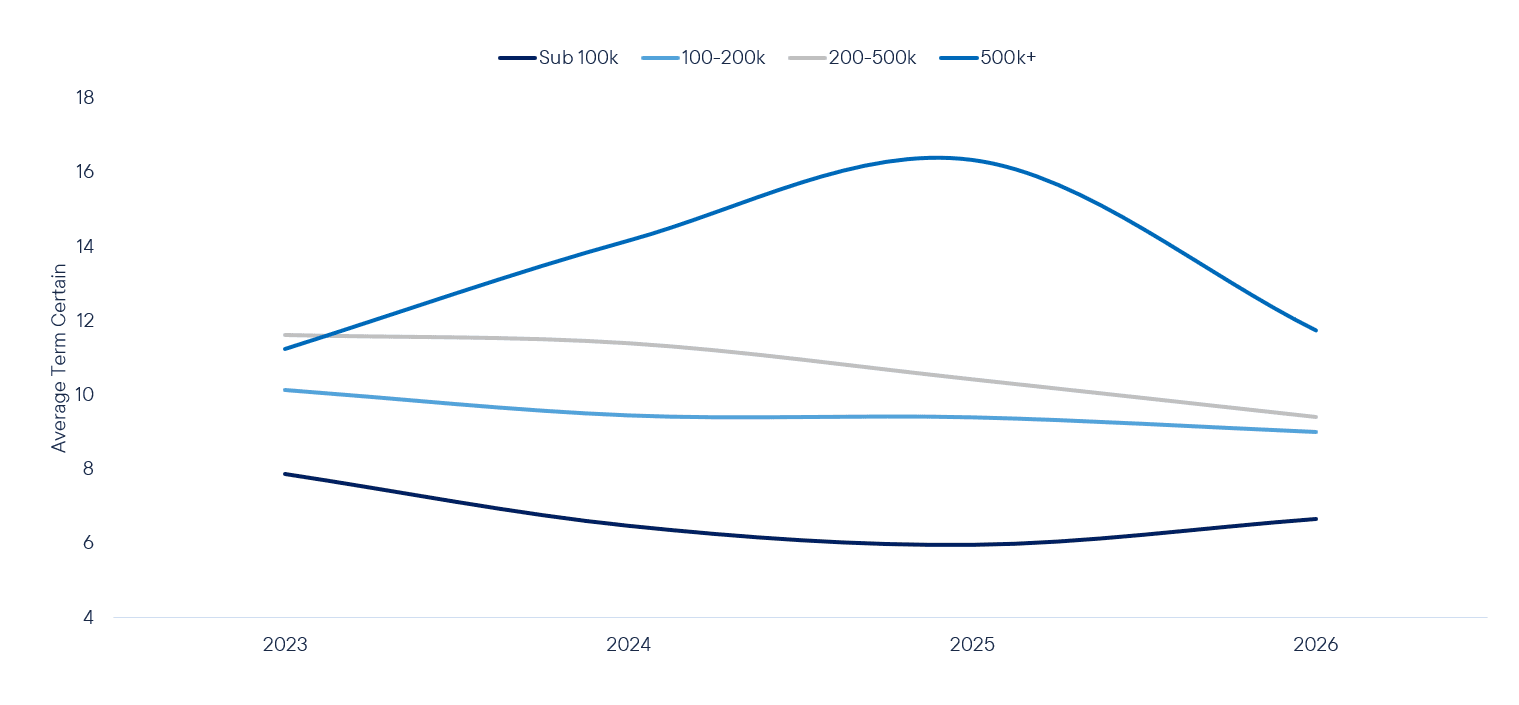
Figure 1: Average term certain by unit size, 2023 to 2026 - Source: DXTRE
Institutional-grade product. Well-designed modern buildings can accommodate a wide range of occupier requirements with meaningful future-proofing built in. Contractor warranty packages give incoming landlords further comfort on ongoing capital expenditure, assuming the right contractor was used.
Pricing. DXTRE data shows a consistent discount in the market for Big Box single-lets relative to multi-let estates. We regard this as an anomaly rather than a durable feature, and one we expect to correct. In the meantime it offers attractive entry pricing today, with clear scope for yield compression on exit. As Figure 2 illustrates, the net initial yield spread between single-let and multi-let industrial has widened markedly through the last 18 months.
Mispriced Risk?
Do the returns on offer reflect the risk being taken? We would argue not. Through disciplined stock selection the risk can be tightly contained, yet the return profile points to internal rates of return in excess of 20% on downside assumptions alone. The breadth of funding and structuring options available means that specific risks, whether planning, construction or, in some cases, even leasing, can usually be substantially mitigated. And the point can be put more starkly. If the only routes to 20% returns in industrial and logistics today are income-producing secondary stock or speculatively developed Big Box, then for us the choice is clear.
20%+ achievable IRRs on downside assumptions, through careful stock selection
As core capital returns to the Big Box space and occupier demand continues to outstrip the supply of Grade A stock, rental growth and yield compression appear more probable within this strategy than within any other we are currently observing.
With significant downside protection and substantial upside potential, Big Box stands out as the most compelling investment strategy in the market today. Specialist knowledge for navigating these nuances against a continually changing economic backdrop has never been more important.
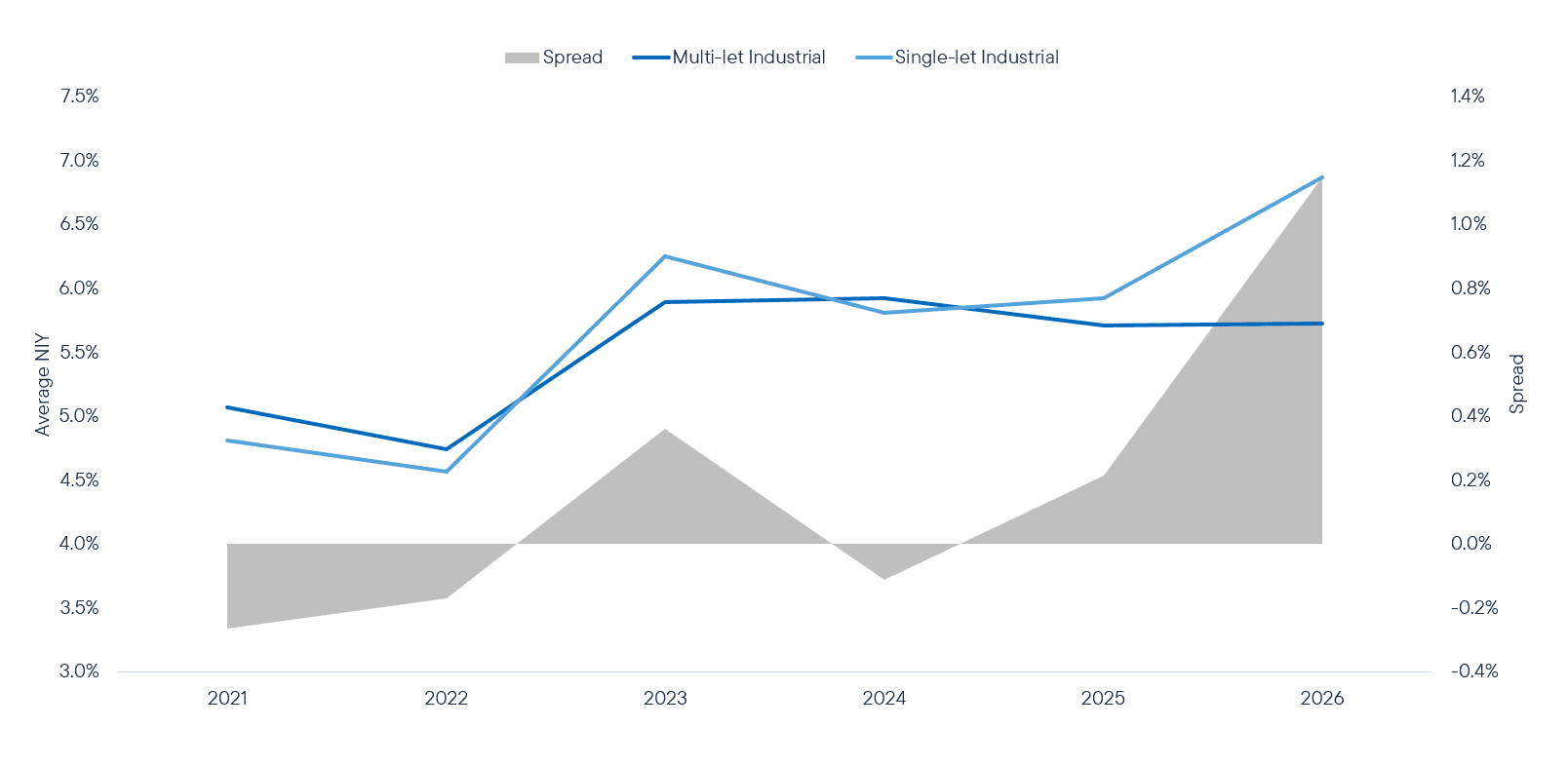
Figure 2: Average net initial yield: single-let versus multi-let industrial, 2021 to 2026 - Source: DXTRE