



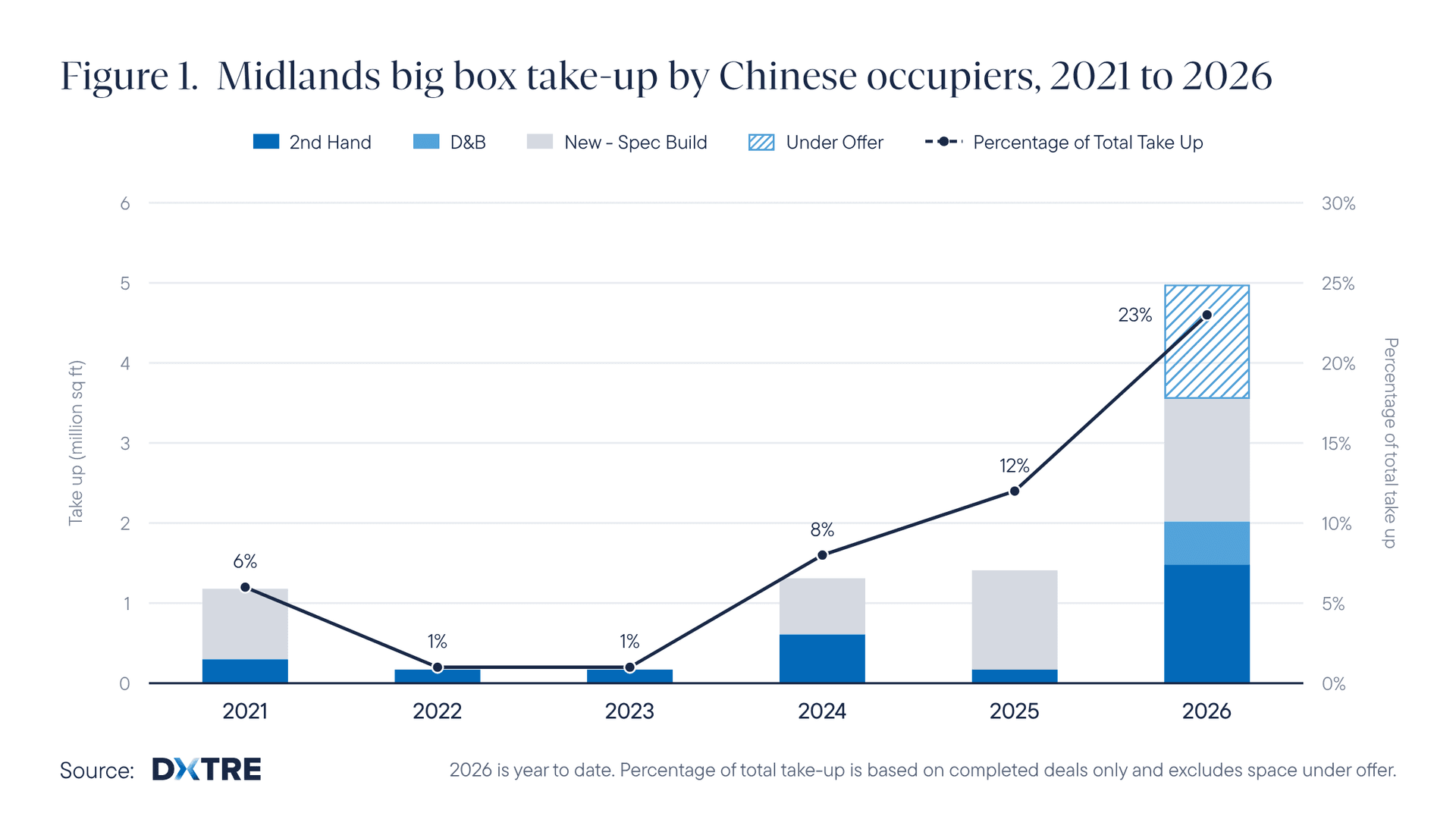
A few years ago, a Chinese occupier taking a UK warehouse was somewhat of an outlier. Today they account for a considerable market share. JD.com, Shein, Temu and TikTok Shop, along with a fast-growing roster of Chinese third-party logistics operators, led by Super Smart, are now among the most active tenants in the UK market, and their take-up has risen rapidly in the last three years.
Why now?
To understand why Chinese occupiers have arrived in the UK so suddenly, you first have to understand how the Chinese e-commerce model actually works.
Two ways a product gets from China to your door.
The first is direct-from-China: you order a £10 top from Shein or Temu, and that item is picked and packed in a warehouse in China, flown to the UK, cleared through customs, and handed to a UK courier such as Royal Mail or Evri for the final leg to your door. Start to finish, that typically takes around seven to twelve days. Crucially, no stock sits in the UK under this model, the warehouse is in China, and Britain provides the courier service.
The second route is the one most shoppers now experience: bulk stock is shipped into the UK in advance and held in a warehouse here, so when you order, the item is picked locally and delivered in two to five days. This is why a Shein order can land on your doorstep in a couple of days. But it requires a UK warehouse.
The £135 Levy
Since 2021, any parcel arriving in the UK worth £135 or less has come in free of customs duty, with only minimal paperwork. That single concession is the foundation the direct-from-China model was built on. It let these businesses treat every individual order as its own tiny, duty-free import, millions of £10 parcels each slipping across the border with almost no paperwork or cost. On that basis, there was little reason to hold stock in Britain at all.
End of the Levy
The Chancellor announced the removal of the relief at the 2025 Autumn Budget, and HMRC confirmed in July 2026 that the new regime will be in force by October 2028 at the latest, sooner than first planned, because the volumes had simply grown too large to ignore: roughly 600 million low-value parcels entered the UK in 2024, around 1.6 million a day, more than half of them from China. From 2028, every low-value parcel will need a full, item-level customs declaration, customs duty will apply on top of VAT, and the liability to pay it falls on the retailer. Three new costs and a layer of paperwork on every single parcel.
Change to the model
This renders the first business model unsustainable. The cheaper answer is to ship the stock into the UK by the container-load, clear customs once on the entire load, hold it in a UK warehouse, and fulfil orders domestically from there. In other words, the route that depends on UK warehousing is becoming the only profitable solution.
Trumponomics
The final piece is Trumponomics. Washington scrapped its own $800 duty-free threshold for Chinese goods in 2025, as part of the wider tariff fight with Beijing. As a result, Temu and Shein's US audiences fell sharply, by more than half on some measures, and while both have since clawed back part through local warehousing, they have redirected marketing and investment towards the UK and Europe.
So is this new demand, or just a 3PL contract shuffle?
It is new demand, for two reasons. First, the fulfilment part of this supply chain has moved to the UK from China, a part of the network that was not here before. Second, the two models need very different amounts of space. Shipping on demand from China meant holding almost no stock in the UK. Holding stock here, competing with Amazon Prime, means keeping thousands of lines sitting in racking at all times. Swapping a just-in-time model for a just-in-case one.
Why the UK?
The UK is the most advanced online retail market in Europe, with close to 30% of all spending done online, well ahead of Germany or France. For a retailer built on selling cheap goods at volume, that makes it very attractive. Brexit reinforces the point: as a separate customs territory from the EU, the UK cannot be served cheaply from a Continental network, so a retailer with serious UK volume needs an operation of its own here.
It would be wrong, though, to assume the UK is the top priority. If anything, the opposite is true. Mainland Europe shops online far less than Britain does, and for that reason the Chinese see a real growth opportunity here and are acting on it. In comparison, the UK is a mature market with deep online habits, a single language and a customs border enforcing a local footprint. The wider European market is where the volume is ultimately expected to come from. What is playing out now is better understood as a race to space, with these businesses scaling at pace to build networks capable of rivalling Amazon’s delivery times.
Who will be on the lease?
It's important to separate two things often pooled together as "Chinese demand". On one side are the retailers: Shein, Temu, TikTok Shop, AliExpress and JD.com (Joybuy). On the other are the fulfilment operators that hold the stock and pick, pack and ship the orders: Super Smart Services (trading as CIRRO, part of the Zongteng group), Top Cloud, Cainiao, SF Express, J&T Express and many others. The 3PLs still sign the larger share of the space, but the retailers are taking a considerable amount in their own right.
JD.com is the outlier, playing three roles at once: retailer through Joybuy, 3PL through JD Logistics, and landlord through its property arm JINGDONG Property.
The reason the retailers increasingly want their own buildings rather than sitting inside a 3PL’s shed is control. Taking the space directly puts the retailer, not the operator, in the driving seat of the contract.
For a landlord, the retailer is not automatically the stronger covenant of the two. A lease to JD.com may be a lease to China's largest retailer by revenue, but the UK entity behind it is yet to reflect this, which is why these deals are routinely done on some degree of surety rather than on the Parent Company’s name. A lease to a fulfilment operator is a different question again: an established 3PL with a broad customer base and a trading record can present as a strong covenant, while a newer, single-contract operator is a weaker credit dependent on contracts that can move. The demand is real either way, but who is on the lease, and what stands behind them, deserves as much scrutiny as the headline rent.
What happens next?
My view is that Chinese e-commerce’s 23% share of take-up this year to date may well prove a high-water mark, but the demand behind it means these occupiers will remain a significant force in the Midlands and other markets for years to come.
The case is straightforward. October 2028 is a fixed, published deadline, and what we are seeing is a response to rising costs forcing a change in business model. That suggests that demand from this sector over the next two to three years will remain strong. It also points to the demand broadening out, both geographically and by size. JD.com is already moving beyond Midlands big box into last mile facilities around London and Manchester, which is exactly what you would expect as these platforms start to build the national next-day networks Amazon built a decade ago. The operators themselves see last-mile as a major growth sector, and a particular gap around bulky goods such as furniture, which the parcel carriers are not set up to handle as efficiently as small packages. So, expect the requirements to spread beyond the big box into smaller, regional space.
The caveat is covenant. A good deal of this demand sits behind young UK entities with short trading histories and a business model more exposed to regulatory and reputational shocks than the typical UK 3PL. Strength varies widely across the group, and landlords are already discriminating: the strongest operators take prime space, while weaker, second-tier names are pushed towards secondary stock.
None of that is a reason to stand back. The same was said of Amazon a decade ago, and of the 3PL sector before that, and the landlords who leaned in early, with the right guarantees, the right lease terms and their eyes open, were the biggest winners.
This is a deep, well-funded and fast-growing pool of demand arriving into an undersupplied market, and it is not going away. The opportunity for landlords and developers is real, provided the deal is treated with as much care as the rent is celebrated. Get that balance right, and this is one of the most compelling occupier stories the UK industrial market has seen in years.