


The maths of Big Box development still works. It has just never had to work this hard. Let me explain why.

Last week I sat at a lunch table with 12 of the most senior people in UK logistics development and construction. Developers, contractors, funders. People who have collectively delivered hundreds of millions of square feet. The premise was a simple question. How does anything get built at these prices? Twelve of the sharpest operators in the sector, and not one of them had a convincing answer, as they had already “pulled every lever available to them”. That should worry anyone who needs a shed in 2027.
The problem is not demand
Occupiers took 17 million sq ft of big box space in the first half of 2026, the strongest first half on record outside the COVID distortion years. Grade A vacancy sits at 2.6% and at current absorption rates, the market holds roughly 6 months of Grade A supply. There is plenty of secondary space on the market, but much of it will not lease and occupiers are increasingly preferring the newer, better built, cheaper to operate, easier to attract staff to, big boxes. Factors which we all must see as a positive overall for the sector.
Rubbing up against that demand there’s just 6 million sq ft of speculative space under construction across the UK, versus a 10-year rolling average of 11 million sq ft. That is a 45% shortfall in the pipeline, in a market absorbing space at near record pace. If demand holds its trajectory, the arithmetic becomes uncomfortable, because the market effectively runs out of new Grade A supply within 12 months.
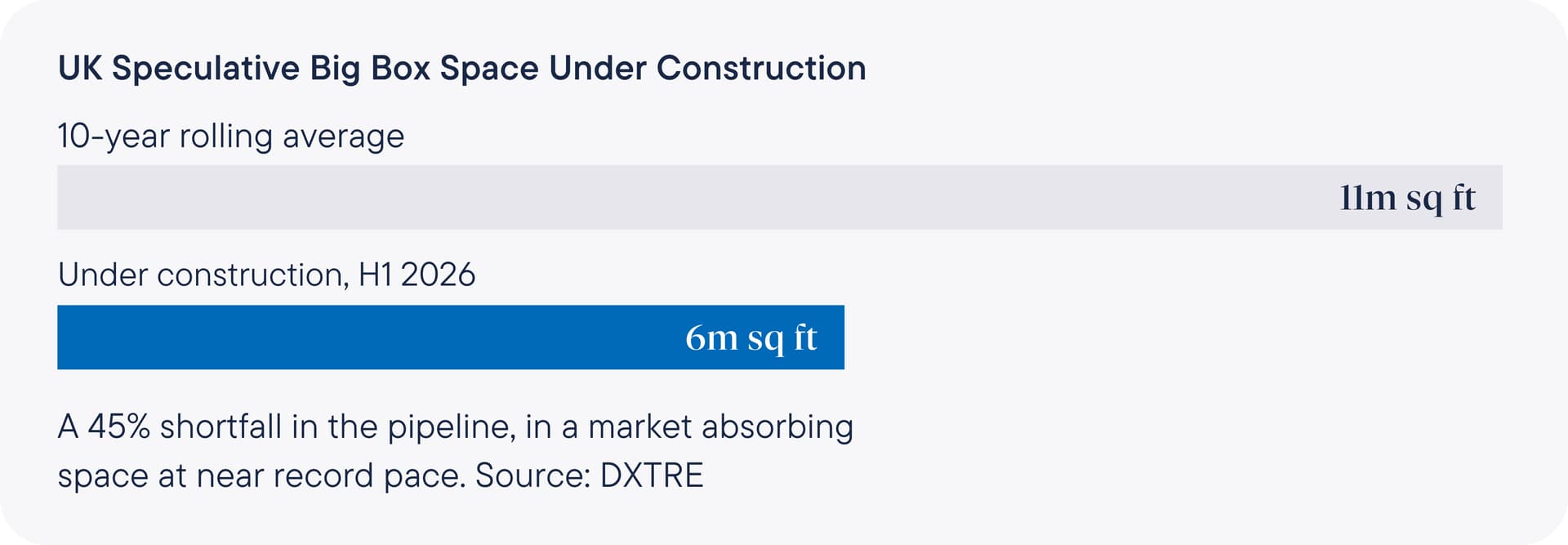
A pipeline shortfall like that is not developers sitting on their hands, nor a collective failure of nerve. It’s rather a rational supply-side response to an appraisal that has become far harder to make stack up. Development still works, but every input is moving at once, with costs rising, rents climbing and yields shifting, and the margin for error has narrowed.
Costs have gone vertical
DXTRE’s build cost tracking shows warehouse construction costs rising between 7% and 9.5% in the second quarter of 2026 alone. Not annualised. In one quarter. In hard numbers, a 500,000 sq ft unit at 18m eaves now prices at £61.58 per sq ft, up from circa £57 in March. Across the range we track, costs run from £54.54 per sq ft on a 1 million sq ft cross-dock at 21m, up to £96.15 per sq ft on a 50,000 sq ft unit at 10m. And in a grim irony, the biggest quarterly increases sit at the large, tall, ross-docked end of the market, precisely the product in shortest supply, because those buildings carry the most steel.
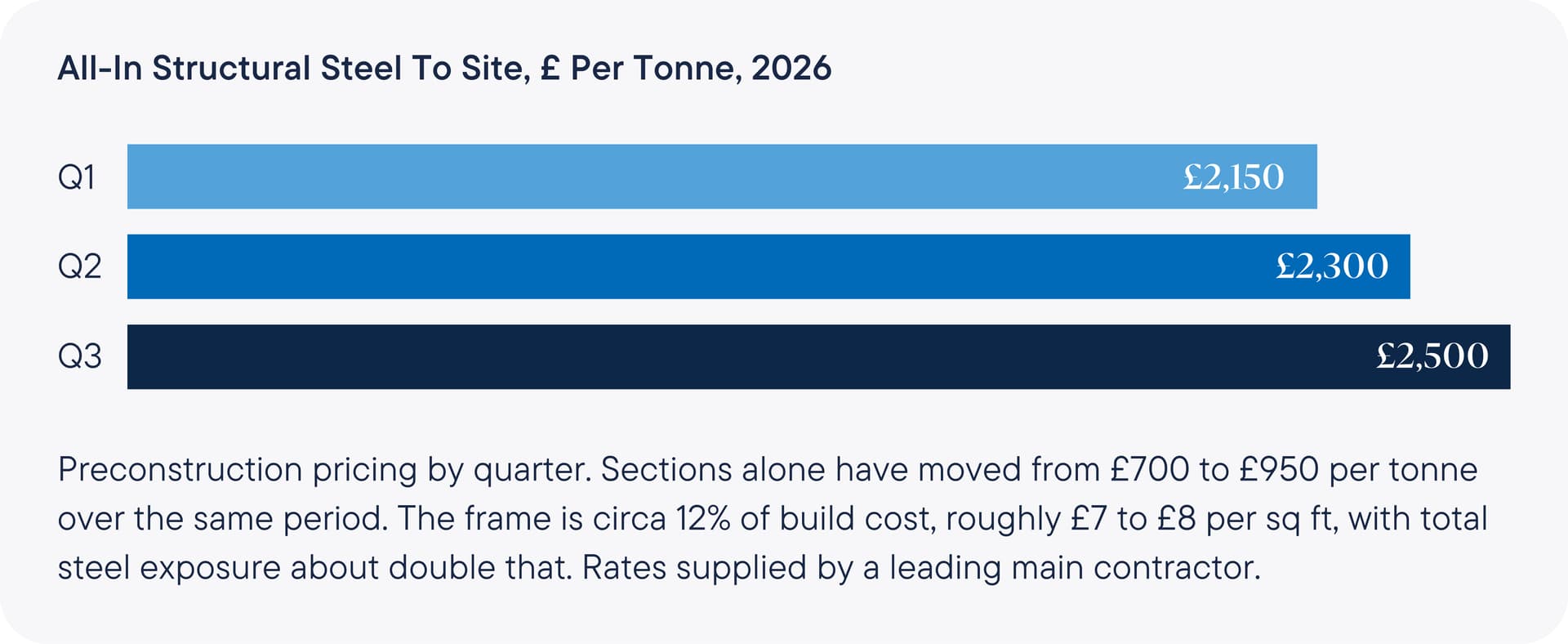
Steel is the flashpoint as sections have moved from £700 to £950 per tonne this year, and since 1st July imports above the government’s tariff-free quota carry a 50% duty. The room’s shared expectation was blunter than any forecast I could publish, namely that domestic prices will drift up to sit just beneath the tariff line, because that is what prices do. And the all-in numbers are no longer market talk. A leading main contractor tells us structural steel is currently pricing at circa £2,500 per tonne to site in the preconstruction phase, up from around £2,150 at the start of the year and £2,300 through the spring, a 16% rise in 6 months. That rate is deliberately forward-looking, because on most big sheds a long earthworks programme means steel ordered today does not land on site until late 2026 or early 2027, so contractors are pricing the unknown impact of the government’s steel strategy, continued volatility in fuel and energy markets, and the growing squeeze on low-carbon EAF steel from Europe as net zero commitments bite. On a typical big box the frame alone is circa 12% of total construction cost, and once cladding, decking and rebar are counted, total steel exposure runs at roughly four times that.
Here is the part that separates this cycle from every previous one. There are no levers left. The industry has spent 20 years value engineering the big box. Frames are optimised, specifications are lean, procurement is professional. In previous cost cycles, developers absorbed inflation through cleverness. That capacity is exhausted. Every pound of cost increase now lands directly on the appraisal. On top of that sit three structural pressures with no release valve.
- A subcontractor market with only 2 to 4 trusted firms per critical package
- Labour rates that reset upwards during COVID and will not unwind
- Power connections that have quadrupled to around £2 million per site
Put those together and you have cost inflation with no shock absorber.
Something has to budge, but what?
There are four candidates, and only the last of them can move quickly.
The first is quality, or more precisely, specification. There is a live and overdue debate about whether the UK builds to an institutional standard when it should build to an occupational one. On the continent, structural materials are treated as commodities, and the same developer will frame a building in steel, concrete or timber depending on what is cheap that quarter. The UK remains stuck on steel at the precise moment steel is the most politically exposed material in the country. A genuine shift here would help, but re-educating an entire investment market about what makes a building fundable is the work of years, not quarters. Nor is this an argument for building worse buildings. Institutional-grade product is what keeps the deepest pool of exit capital engaged, and a pound saved on specification can cost a multiple of that on exit.
The second is land. In a functioning market, development economics repair themselves through the residual, where rising costs push land values down to compensate. In practice, land is the stickiest input there is. Landowners anchor to yesterday’s price, sites are optioned at yesterday’s assumptions, and nobody sells into weakness unless they must. Land will budge as it always does but again, it budges over years, and the supply hole is being dug now.
The third is pricing, meaning rents and exit values. Rental growth is running at roughly 3.5% nationally, with the strongest geographies already well ahead of that, and the 3.5% itself is best read as a base case with downside protection rather than a ceiling. Even so, no rental number in the market is tracking a 9% quarterly build cost move. The inflation maths on rents is instructive. The first generation of big box rents from the 1990s on Magna Park Lutterworth, adjusted for inflation alone, would sit around £16 per sq ft today, and the market remains well below that. There is clear headroom in what occupiers can bear relative to their total operational costs, and a supply squeeze of this severity will force rents through it. The penny has already dropped with some occupier advisors and they have confidently advised their clients to accept this rental growth in order to solve their operational need but more will need to follow. Meanwhile, every quarter of cost inflation raises the replacement cost of standing prime stock (which, whisper it quietly, is in turn making a strong argument for buying and owning standing stock).
The fourth is the appetite to fund risk. This is the lever most likely to move first, because it is the only one that does not require anyone to build, buy or re-educate anything or anyone. It requires a funder to change their mind, It requires a funder to change their mind, and the, case for changing it strengthens every quarter.
- Rents rising
- Supply falling
- Demand rising
- Voids shortening
- Incentives falling
Development risk has not gone away, but funders are, in our view, disproportionately bearish right now. The typical underwrite prices today’s challenging conditions in full while giving no credit to the rental growth, ‘core’ exit opportunities and consequential yield compression coming down the tracks, even though every one of those five lines pushes risk-adjusted returns in the same direction. The funders able to price the medium term trajectory, rather than just today’s conditions, are likely to be rewarded for it. If speculative development restarts into this vacuum, it restarts here, with whoever reprices that risk first.
My best guess is that all four budge, and that funding appetite budges first. The market clears a way through a thin 2027 delivery pipeline by moving rents upwards, by land being repriced (though largely at the margins), by prime stock benefitting from a pricing uplift due to demand and supply imbalances, and by capital accepting more development risk for the returns now on offer.
However, as outlined, there is no quick fix and the winners over the next 24 months will be those already holding land at sensible cost, those with the balance sheet to start speculatively into a supply vacuum, those with the occupier relationships to de-risk through pre-lets, those volume developers who build the most and thereby have the strongest leverage with the tier 1 contracting market, and those funders willing to underwrite the trajectory of rents and yields rather than just today’s conditions, because by the time the evidence is unarguable the return will have been competed away. For everyone else, it’s time to get creative, and realistic.
That final lever deserves a piece of its own, and it gets one. Big Box is Back: Fortune Favours the Brave follows next week, setting out why the returns on offer for taking development risk now outweigh the risks being priced. If this piece explains why something has to budge, next week’s explains who gets rewarded when it does.